Civil discourse doesn't have to be this hard.
Something is broken about the way Americans talk to each other. Not just online — in real life too. We stopped disagreeing and started assuming the worst. We stopped listening and started performing. We have more access to information than any generation in history, and yet we understand each other less.
Parley is a solution to that. ParleyPixel is the funding strategy for Parley.
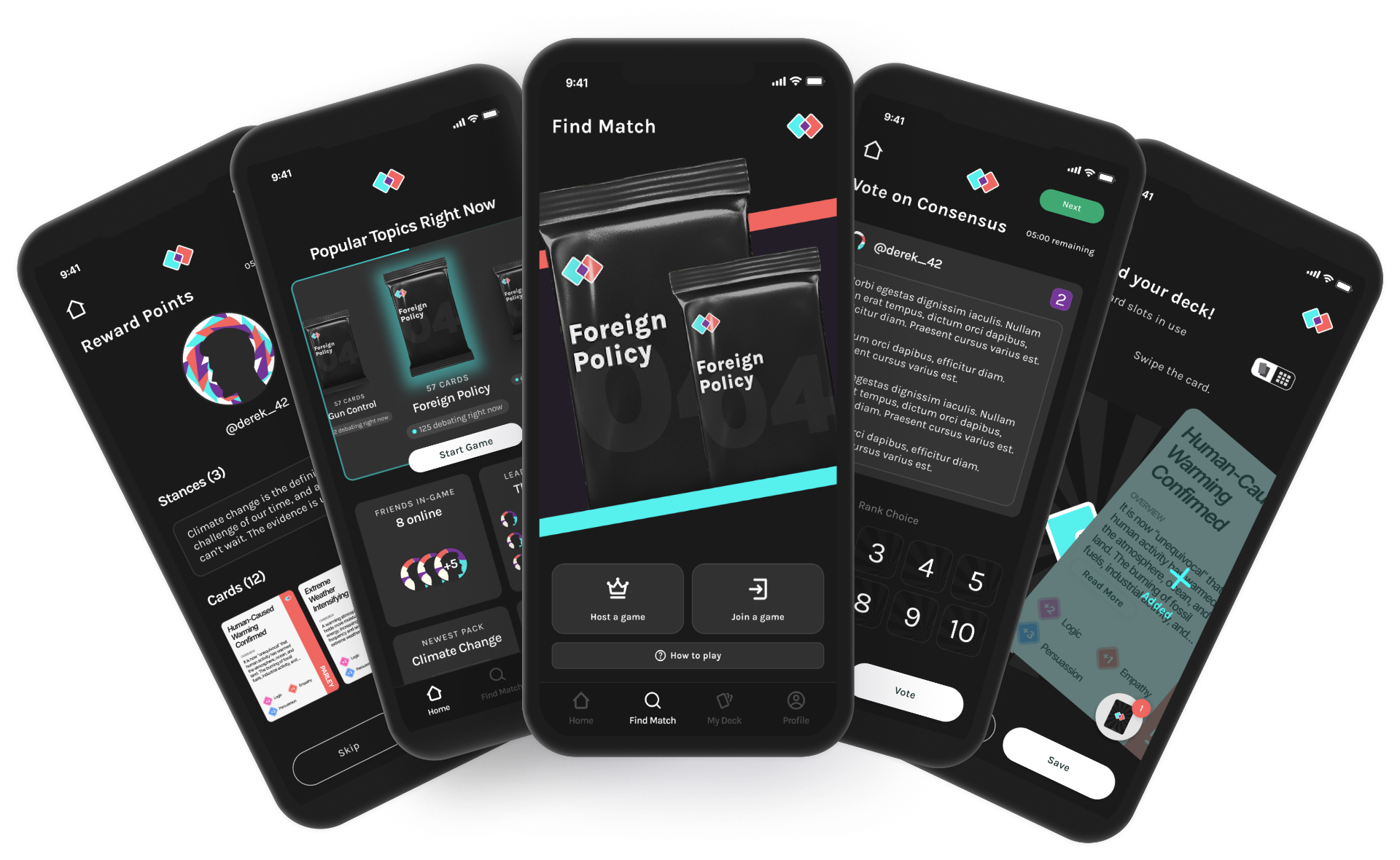
Parley is a gamified discourse app that turns polarized political discussion into structured, fact-based dialogue. Players build decks from verified info cards, debate opponents in timed rounds, and score each other on logic and empathy. Every session ends with a reflection dashboard — making civil discourse competitive, rewarding, and shareable.
The data is harder to ignore than the feeling.
These numbers are not partisan. They come from nonpartisan research institutions and reflect what people across the political spectrum are experiencing.
of U.S. adults say the country is greatly divided on the most important values — a record high.
of Americans say they feel exhausted by the division in America.
of Americans describe fellow citizens as morally bad — the only country of 25 surveyed where that is true.
of Americans say politicians are more focused on fighting each other than solving problems.
The problem is not a lack of political information. The problem is the absence of a structured, safe space for cross-partisan conversation — one that rewards understanding over winning. That is what Parley is built to fix.
Parley is not about winning a debate.
Most political conversations are built around one goal: beat the other person. Parley is built around a different goal entirely. The point is not to win. The point is to understand — your own views more clearly, and the views of someone who sees the world differently, backed by vetted, peer-reviewed data that neither side can argue with.
Parley is a civil discourse platform — part civic game, part structured debate, part research tool. Players select topic decks built from peer-reviewed facts. They make timed opening statements, vote on each other's arguments using an empathy scale, and work toward ranked-choice solution voting that surfaces the strongest argument — not the loudest one.
Every session generates anonymized data that builds a proprietary civic engagement dataset — infrastructure for understanding how people actually think and communicate across political lines at scale.
Parley is non-partisan by design.
Parley does not take sides. It does not amplify one ideology over another. Parley never asks for or records a user's political affiliation. Your ideology is your own. It gives both sides the same tools, the same vetted facts, and the same structured space. The platform is built on the belief that most people, given the right conditions, are capable of genuine conversation.
Five steps. One better conversation.
- 01Select a topic deck
Players choose from decks populated with peer-reviewed, vetted facts on issues that matter.
- 02Make your opening statement
Timed statements keep the conversation structured. Everyone gets the floor.
- 03Vote on empathy
Responses are scored on a 1 to 5 empathy scale — not on who sounds the most confident.
- 04Ranked-choice solution voting
The group votes on the strongest argument. The best idea wins, not the loudest voice.
- 05Session readout
A full summary keeps the conversation constructive and gives everyone something to take away.
Built on what real people told us.
Parley's design is grounded in two completed research studies and interviews with users across the political spectrum. Users consistently said they want honesty, nuance, and quality information — but feel hostility, exhaustion, and a lack of forward movement in political conversations online.
The tribalism of debates is awful.
It is valuable to have the perspective of the other side.
Allowing people to have the floor and not be interrupted is valuable.
Those three insights — tribalism, perspective, and the value of being heard — are the design pillars Parley is built on.
The design is done. The build is next.
Parley has been in active design and research since 2024. What you're looking at in the prototype is the result of 50+ screens, 4 design pivots, 2 rounds of user research, and a fully interactive prototype. This is not a concept. It is a product ready to be built.
View the interactive prototype: Parley Prototype
The problem is real. The solution is ready.
ParleyPixel is the first chapter of something larger. It is the first product from a civic tech studio — with more tools for civic understanding, engagement, and discourse to follow. Every pixel sold is proof that two communities can share a space without chaos. That is what we are scaling.
Who is behind this.
My name is John Dufresne. I'm a senior UX designer and product manager with over a decade of experience designing products at scale. My most recent role was leading a UX research program — four years of usability testing, Figma prototyping, A/B testing, and cross-functional collaboration across web, mobile, and app platforms.
I started designing Parley in 2024 because I believed — and still believe — that the tools for civil discourse don't exist yet in a form that works for most people. I run Rocketbean Studio, a creative and design venture, where Parley and ParleyPixel are the first of what I intend to be a suite of civic tech products.
Ready to be part of it?
Claim your pixels. Fund the platform. Be on the wall.